Brekkie
Thu Sep 13, 2012 5:47 pm
Libya: US Consulate destroyed, Ambassador slain
Thought I'd make a thread in case anyone had any questions/wanted some context/need help making sense of the news reports deluge.

SIDEBAR: “What is the difference between an Embassy and a Consulate?”
The Embassy is located in the nation's capitol city. It contains the Ambassador. The Ambassador is the senior diplomatic representative of the United States, to the government of the host country.
A Consulate is a section responsible for issuing tourist and immigration visas for entry to the United States, and assisting American citizens living and traveling in that country. It is headed by a Consul General.
Generally there will be a Consulate in each major city within the country, each with it's own Consul General. In the capitol city, the Consulate will be a section within the Embassy. All Consulates within the country are subordinate to the Embassy, and the Ambassador. There is only one Ambassador, but there is a Consul General for every Consulate.
SIDEBAR: “The Innocence of Muslims” Movie
As you can see, the movie is a disjointed collage of scenes intended to offend Muslims. It depicts Mohammed as a bastard, a homosexual, and a pedophile. It shows him ordering massacres and pillaging innocents. It depicts the writing of the Koran as being a stream of consciousness text based on Mohammed’s convenient self-justifications and whims, and plagiarisms from the Torah and the New Testament. It depicts Mohammed saying he will appoint Omar (an important successor of Mohammed for Sunni Muslims) as Caliph to get his wife to stay silent about the fact that Mohammed raped Omar’s daughter.
It is also an incredibly shitty, basement piece of film-making. The actors who appeared in it had no idea what it was about or that they were depicting Mohammed. Every reference to Islam or Mohammed or the Koran in the movie did not appear in the script, but was dubbed over in post-production. The actors thought they were appearing in a generic movie about a medieval Egyptian.
The creator is an Israeli Jew named Sam Bacile, who works in real estate in California. He is a self-proclaimed anti-Islam crusader, dedicated to “exposing the abominations of Islam”. He allies himself to an extremist Coptic Christian preacher who protests the treatment of Coptics in Egypt.
The movie, however, was published to Youtube in English, and would not have reached a significant audience under normal circumstances. However, someone dubbed it over in Egyptian Arabic and set it viral on social media in the Middle East.
SIDEBAR: “Who was defending the US Consulate?”
US Embassies and Consulates are generally built like castles. They have powerful structural defenses, and are protected by concentric layers of security and security personnel.
1) The outer layer of protection is supposed to be the police/military of the host government, in this case, the Libyan government militia. However the Libyan forces are still relatively disorganized and dispersed, and so Libyan forces were not able to get to the Consulate until too late. (In Cairo, by comparison, the Egyptian police formed a cordon around the Embassy when the protest formed, but lost their nerve and ran away when they saw how badly they were outnumbered.)
2) The next layer of defense is the Local Guard Force (LGF for short), which are basically local mercenaries that are hired and trained by the US State Department’s Diplomatic Security agency. These security guards man the perimeter walls and the vehicle entrance gates, but do not come in the actual secure embassy building. Going back to the castle metaphor, they are on the outer bailey wall, whereas the Americans are all in the keep.
3) The final line, and most powerful, line of defense are the Regional Security Officers, and the Marines. US Embassies and Consulates typically are defended by a detachment of highly-trained US Marine Security Guards (MSGs for short). They are commanded operationally by a group of Diplomatic Security Special Agents called Regional Security Officers. In truly extreme cases where an embassy is under assault and the outer perimeter is breached, the MSGs will secure the primary building from entry and repel anyone who attempts to storm it.
There were no Marines are Benghazi.
Why? A few different reasons:
1) The role of Marine Security Guards is a little bit more complex than simple physical security. Their primary responsibility is preventing the compromise of classified information and sensitive national security information and facilities. I can’t go into more detail than that, unfortunately. This is significant because Consulates normally do not contain any of this, being focused on issuing visas and other simple administrative work. So they often do not have any Marines assigned to them. Some do, most do not.
2) There is a shortage of MSGs right now. And as recently as 6 months ago, some powerful voices in government were considering the idea of eliminating the MSG battalion altogether. They’d forgotten the lessons of the Iranian Hostage Crisis, and were looking to weaken security by exchanging United States Marines for private contractors. Significantly, no one is saying that any more now.
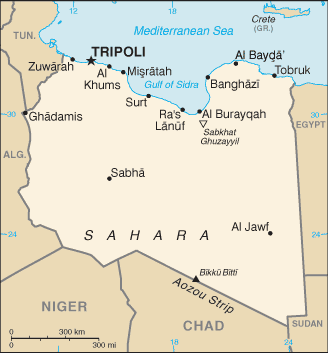
3) The Consulate in Benghazi was not meant to be a permanent facility. It is (how shall I put this lightly?), pretty “ghetto”. It’s literally a motel building complex that we requisition for the US diplomatic delegation to the rebellion for the simple reason that it was located in one of the only areas they had under their control at the time. The delegation landed, took a look around, found an abandoned motel building and said “it’ll do for now”. And we kind of just kept adding on to it. It is not very defensible, and it almost completely lacked any of the defensive features that other US facilities have. Now that the regime has been toppled and the democratic government is in place, an actual Embassy in the capitol of Tripoli has been opened, and the Consulate in Benghazi was supposed to be getting closed or rebuilt, but we simply hadn’t gotten around to it yet.
So when the attack commenced, the defenders consisted of the Local Guard Force, and a few American Regional Security Officers.
SIDEBAR: “I thought the Libyans dragged Ambassador Stevens’ body through the streets?”
There is a picture floating around showing a shot that was aired on Al Jezreera TV.
Pundits have been claiming it shows a mob dragging the body triumphantly through the streets.
Note, however, the way they are carrying the body. Upright, like you would carry a wounded casualty. Not by its ankles, dragging across the ground.
This picture shows ordinary Libyans rushing the body to the hospital and to the other Americans.
SIDEBAR: "I heard that the US Ambassador in Cairo ordered that the Marines were not allowed to have live ammunition, and forced them to stand down and not defend the embassy."
This is 100% fabrication by conservative bloggers, and not true.
Sagara wrote:Agreed as well. From the original data available to me (casual information gathering) it seemed as if a civilian mob had gone sour.
I guess the situation was too complicated to make good headlines :-/
SIDEBAR: "I heard that the US Ambassador in Cairo ordered that the Marines were not allowed to have live ammunition, and forced them to stand down and not defend the embassy."
This is 100% fabrication by conservative bloggers, and not true.
Brekkie wrote:At some point, an American consulate worker was killed by a gunshot wound in the crossfire while evacuating.

Brekkie wrote:I am currently a Marine Security Guard.
I am not currently in Libya, but have contacts there, and at other hotspots.
bldavis wrote:Brekkie wrote:I am currently a Marine Security Guard.
I am not currently in Libya, but have contacts there, and at other hotspots.
arent you in Suadia Arabia?

From: Cross, Alex Maj OLA, LA-41B
Sent: Thursday, September 13, 2012 4:55 PM
To: Cross, Alex Maj OLA, LA-41B
Subject: Marines in Libya and Egypt
Ladies and Gentlemen-
The following information is provided regarding Marine involvement in the recent actions in Egypt and Libya:
Egypt:
-The Ambassador did not impose restrictions on weapons or weapons status on the Marine Corps Embassy Security Group (MCESG) detachment. The MCESG Marines in Cairo were allowed to have live ammunition in their weapons. The Ambassador and Regional Security Officer have been completely and appropriately engaged with the security situation. Reports of Marines not being able to have their weapons loaded per direction from the Ambassador are not accurate.
- The Marine Corps does not establish Rules of Engagement (ROE). Nonetheless, ROE is classified and release of that information would jeopardize the Marines and U.S. interests. Any further inquiry should be directed to the State Department, since Marine security guards report to the ambassador not to a military commander.
-As reported in open sources, approximately 2000 personnel were protesting outside the U.S. Embassy and six individuals entered Embassy grounds. The Marines quickly took control of these six individuals and subsequently turned them over to local security officials.
-There were no Marines injured in this, or other actions in Cairo.
-There are no Marine dependents in Cairo.
Libya:
-Contrary to open source reporting, there are no Marines currently stationed at the Embassy in Tripoli, or the Consulate in Benghazi.
-There were no Marines killed in the attack on the Consulate in Benghazi.
Yemen:
-The American Embassy in Sana'a, Yemen has a MCESG reinforced with a Marine security force. Due to operational security, we are not at liberty to provide additional details at this time.
Marine Corps Embassy Security Guards (MCESG):
Embassy security in Tripoli and the consulate in Benghazi fall under the Regional Security Officer with the State Department. The U.S. maintains over 285 diplomatic facilities worldwide. MCESG provides 152 security detachments provide internal security at designated U.S. diplomatic and consular facilities in order to prevent the compromise of classified material vital to the national security of the United States. Perimeter security is the responsibility of the host nation police/security forces. AMEMB Tripoli does not have a MCESG detachment. Typically, when a new embassy is established, it takes time to grow a new MCESG detachment. In coordination with the State Department, there was discussion about establishing a detachment in Tripoli sometime in the next five years. Overall, the plan is to grow the number of MCESG detachments worldwide to 173. The size of a MCESG detachment depends on the size of the Embassy and the security situation on the ground. They normally range anywhere from 5-20+ Marines in size. MCESG can, and have, provided security at Consulates as well as Embassies. For example, Marines guard the US Consulate in Hong Kong and, in the past, have guarded the US Consulate in addition to the Embassy in Haiti. The decision as to which consulates receive this augmented security lies with the State Department. State identifies its requirements and DOD/Marines work to provide it. A U.S. Ambassador serving in an unstable region can/will normally have a security detail provided by the State Departments Diplomatic Security Corps. State has agents specially trained to provide personal security details (similar to the Secret Service). Stephanie Hoostal at the State Liaison Office (B-330) can be reached at 6-4542 if you have questions specific to the State Dept.
Fleet Anti-Terrorism Support Team (FAST):
A FAST platoon deployed to Libya yesterday (12 Sep 12) to provide security for the U.S. Embassy in Tripoli. Established in 1987, FAST platoons provide a limited-duration, expeditionary security force to protect vital naval and national assets. FAST companies maintain forward-deployed platoons at various naval commands around the globe and possess U.S.-based alert forces capable of rapidly responding to unforeseen contingencies worldwide. FAST is not designed to provide a permanent security force for installations. FAST platoons are primarily designed to conduct defensive combat operations, military security operations, and rear area security operations in response to approved requests in support of geographic combatant and fleet commanders. When deployed to reinforce embassies with existing MCESG detachments, FAST platoons will customarily provide an outer cordon of security inside the embassy compound, while MCESG Marines maintain security of the chancery proper, and host nation police/security forces provide an outer cordon of security beyond embassy grounds.
NOTE: Although a Marine Expeditionary Unit (MEU) has traditionally been forward deployed to the Mediterranean (2.5 MEU forward deployment-1 x east coast MEU to the Med, 1 x west coast MEU to the Pacific, and the 31st MEU forward based out of Okinawa, Japan), there is currently no MEU presence in the Mediterranean. The Marine Corps currently maintains a 1.5 MEU presence forward deployed. We currently have the 24th MEU from the east coast deployed to the Persian Gulf, a west coast MEU is conducting work-ups for deployment, and the 31st MEU is operating from Okinawa.
Please see the attachments for more information on FAST or MCESG. If you have any questions, please do not hesitate to contact your Marine Corps Liaison Office in RHOB-B324.
Respectfully,
Alex Cross, Maj USMC
Deputy Director, Marine Liaison Office
U.S. House of Representatives
B-324 Rayburn
